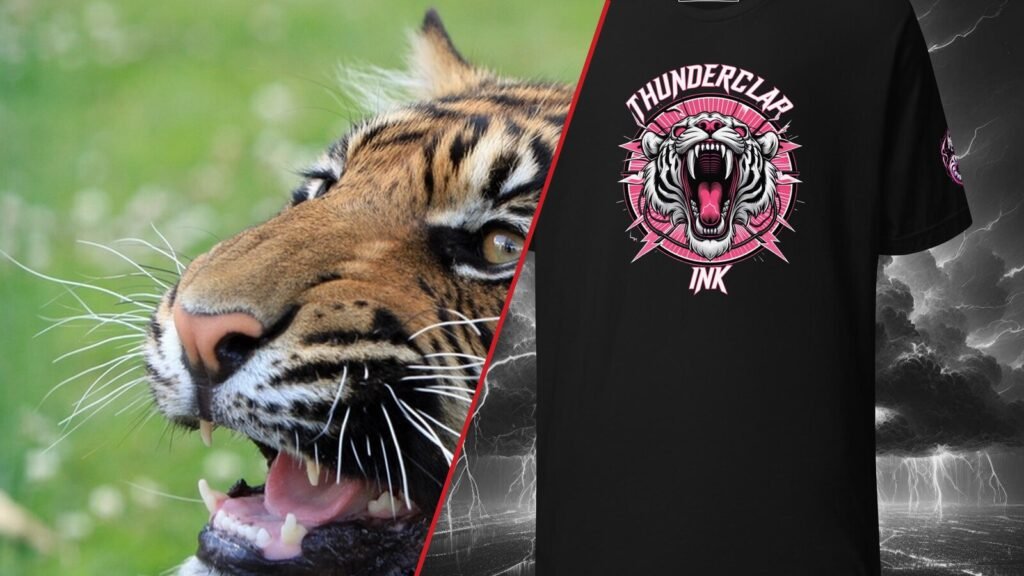
Here is the strange part most people never learn: a tiger’s stripes are not just a coat pattern. They run down into the skin. Shave a tiger bald and the same arrangement of dark and light would still be visible on the hide underneath, like a tattoo that was never inked but grown. No two tigers carry the same layout, not even littermates raised in the same enclosure, which is what makes stripes one of the most reliable ID systems in the animal kingdom, rivaling a human fingerprint or a zebra’s flank.
A pattern written into the skin, not just the fur
Stripes form early, while a tiger is still developing in the womb, through the same kind of pigment-cell signalling that produces spots, rosettes and other big-cat markings. The pattern is fixed by birth and stays essentially unchanged for the animal’s life, aside from stretching slightly as the tiger grows. Because the arrangement is genetic and developmental rather than incidental, it behaves like a signature: consistent, individual, and legible from a distance if you know what to look for.
Why the left side never matches the right
One detail trips up a lot of people who assume symmetry. A tiger’s left flank and right flank carry different stripe patterns from each other. They are not mirror images. This means a single photograph of one side of an animal is not enough to identify it fully, researchers doing fieldwork have to catalogue both flanks separately, effectively building two ID cards per tiger rather than one. Miss a photo of the correct side in a camera-trap sequence and you can lose track of an individual entirely, mistaking it for a stranger to the population.
How researchers turn stripes into a census tool
This is the practical payoff of a pattern that never repeats. Field biologists studying wild tiger populations rely heavily on camera traps set along trails and waterholes, and every image that comes back is compared against a growing library of known individuals by their stripe patterns. It is a form of mark-recapture, a statistical method borrowed from fisheries science, adapted here without ever touching the animal. A tiger photographed in one location and again months later at a different camera can be matched by eye or with pattern-recognition software, confirming range, movement and survival without a collar or a dart.
- Camera traps are placed in pairs to capture both flanks in the same pass.
- Analysts compare stripe segments the way forensic examiners compare fingerprint ridges, focusing on junctions and breaks rather than the whole image.
- Repeated sightings of the same individual over time build a rough picture of home range and, over years, of population trends.
None of this requires touching the tiger, which matters in landscapes where every capture event carries risk for both the animal and the research team. Stripes let scientists study a notoriously elusive, solitary predator by watching from a distance, patiently building recognition rather than relying on physical tagging.
What this means for tigers in the wild
Counting a species that moves alone, at night, through dense cover is difficult under the best conditions. Stripe-based identification does not solve the deeper pressures tigers face, fragmented forest, shrinking prey, contact with human settlements, but it gives researchers a way to actually know who is out there, whether an individual is still turning up in later surveys, and how far animals are ranging as habitat shifts. That data underpins almost every serious estimate of wild tiger numbers used in conservation planning today.
It is worth sitting with the odd intimacy of that fact: an animal built for concealment turns out to be carrying, on its own skin, the exact information a scientist half a world away needs to recognise it again. The Electric Bubble King of Spades Tiger hoodie takes that same idea of pattern as identity and pushes it into something more graphic and electric, but the root of it is the same animal fact: a coat that is never repeated twice.
Thunderclap Ink puts these details on record because the stories behind the designs are worth knowing, not just the artwork itself.
Wear the Roar
Our Electric Bubble King of Spades Tiger – Unisex Hoodie (Light Collection) is for animals like these. And for the people who go and get them out.


15% of the profit from every purchase goes to animal conservation foundations around the planet.
Wildlife and nature art on apparel and phone cases. Wear it, and fund the work.
Join the storm
New drops, rescue stories and 10% off your first order.