
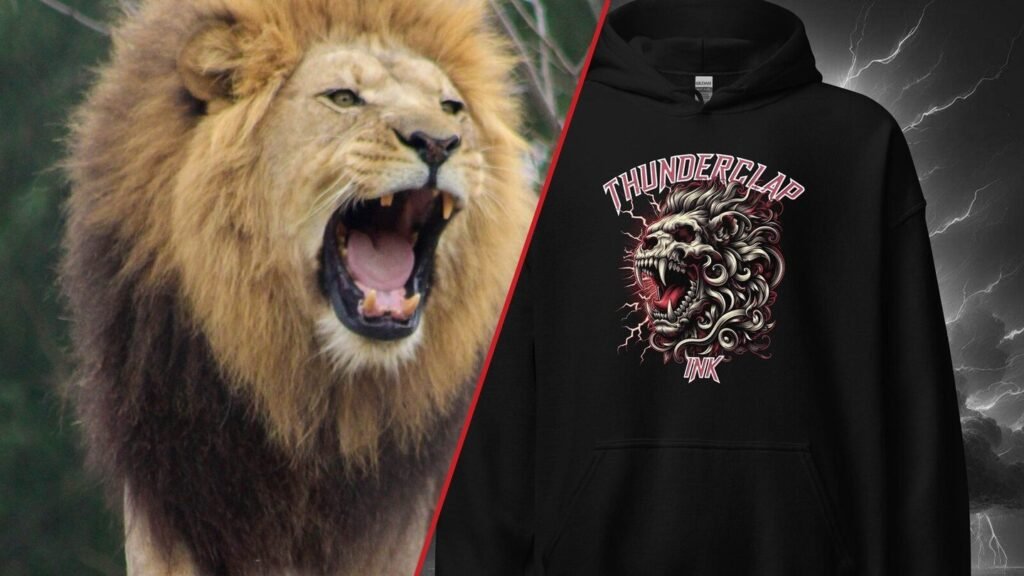
A lion’s roar carries five miles. It is not a noise an animal makes because it is angry. It is a claim. I am here. This is mine. I am still standing.
Now imagine that sound coming out of a steel box on the back of a truck.
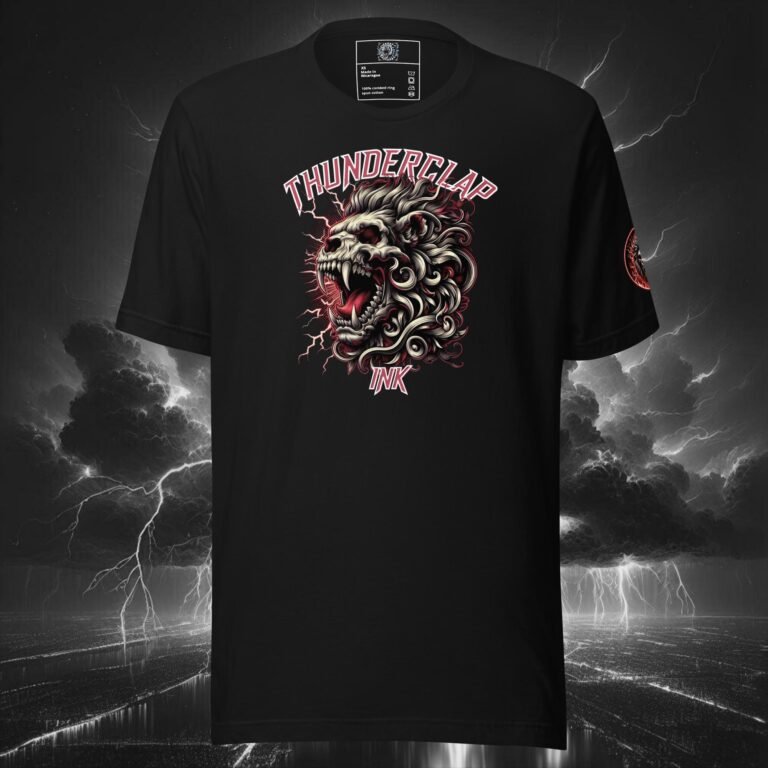
That is where our Inferno Roar Lion comes from. The skull wrapped in fire, the lightning cracking off the mane — it was never meant to be a monster. It is what a creature looks like when it has been through hell and refuses to go quietly. The flames in that design are not consuming him. He is wearing them.
And here is the part most people don’t know: lions have actually done this. Real ones. With names.
The Inferno Was Real
For decades, travelling circuses across South America kept lions in cages barely longer than their own bodies, mounted on flatbed trucks that never stopped moving. No grass. No shade. No horizon.
When Animal Defenders International (ADI) finally reached these animals, the veterinary reports read like torture documentation. Lions with their toes cut off to remove their claws. Lions whose canine teeth had been smashed out so they could not defend themselves. Animals fed on scraps, riddled with parasites, muscles wasted from a lifetime of never being able to run.
They were burning. Slowly. In full public view, for the price of a ticket.
Twenty-Five Lions and One Impossible Airlift
In 2011, Bolivia became the first country on earth to ban every animal from every circus. Passing the law was one thing. Enforcing it meant physically going in and taking the animals out.
ADI did exactly that. Circus by circus, raid by raid, backed by Bolivian authorities, they seized 25 lions from eight different circuses — and then faced a problem no one had solved before: where do you put twenty-five traumatised apex predators?
The answer was a chartered cargo plane. Operation Lion Ark flew all 25 lions from Bolivia to an 80-acre habitat at The Wild Animal Sanctuary in Colorado. It remains one of the largest lion rescues ever attempted, and it did something no campaign had ever managed: it shut down an entire country’s animal circus industry in a single stroke.
Lions who had spent their whole lives on a truck bed walked out onto open ground and, for the first time, kept walking because there was somewhere to go.
Thirty-Three Lions Going Home
Five years later, ADI went further.
Operation Spirit of Freedom was a two-year campaign across Peru and Colombia that tracked down illegal circuses, raided them, and rescued more than 100 animals — bears, monkeys, a tiger, and 33 lions.
In May 2016, those 33 lions were loaded onto an MD-11 cargo aircraft. It collected nine lions in Bogotá, flew to Lima for twenty-four more, and then crossed the Atlantic to Johannesburg. The largest airlift of lions in history. The flight alone cost $330,000, paid for entirely by ADI and its donors.
Most of those lions had never seen Africa. Most had never seen open sky. They were going to a continent they knew only through instinct.
We won’t pretend the story ended neatly there — it didn’t, and ADI has spent years since fighting through the courts to get those survivors somewhere better. Rescue is not a moment. It is a commitment that outlasts the headline.
Leo
If you only remember one of them, remember Leo.
Leo was taken on the very first day of the Peru operation. The circus holding him had also been keeping his mate, Muneca, and his daughters, Africa and Kiara — and when ADI moved in, the circus blocked the rest of the seizure, then vanished with his family before a court could rule.
Leo was free. His family was gone.
ADI did not let it go. For eight months they hunted that circus across Peru, and eventually found it more than 600 miles away, in a remote region near the Ecuadorian border. They got Muneca, Africa and Kiara out.
Then came the reunion that went around the world. Leo had just come through three hours of dental surgery to repair the canine teeth the circus had smashed. He was groggy, barely able to hold himself up on the anaesthetic — and he was still dragging himself toward the fence, because Africa was on the other side of it calling for her father and reaching for him.
He had nothing left. He went anyway.
Leo lived out the rest of his life free, in Africa, with his pride around him, and died at the ADI Wildlife Sanctuary in 2024 — an old lion, in the sun, on real ground.
That’s the Roar
This is why the lion on our hoodie is made of fire instead of being destroyed by it.
Every animal in this story had every reason to break. Cages too small to turn around in. Teeth smashed. Claws cut out. Years of it. And when the door finally opened, not one of them crawled — they walked out and they roared.
But none of them opened that door themselves. Someone had to fly to Bolivia. Someone had to spend eight months chasing a circus across a country to find one lion’s daughters. Someone had to raise $330,000 for a plane ticket home.
That’s the other half of the design, and it’s the half people miss. The fire isn’t only the animal’s rage. It’s what happens when a creature that refuses to give up meets a human being who refuses to look away.
Wear the Roar
Our Inferno Roar Lion is for lions like Leo — and for the people who go and get them out.

15% of the profit from every Thunderclap Ink order goes to animal conservation foundations.
Hero image, left: “Lion roaring.” by Michelle Frechette, released under CC0 (public domain), via Openverse. Right: Thunderclap Ink “Inferno Roar Lion” hoodie. Rescue accounts sourced from Animal Defenders International.
Join the storm
New drops, rescue stories and 10% off your first order.